tsoileau@fostermarketing.com
Amp Up Your Content Generation Efforts … But Only If It Means ROI

Amp Up Your Content Generation Efforts … But Only If It Means ROI

Effective content generation gets results … but how do you get those results and return on your investment? It’s by planning, creating a strategy and implementing your goals – whether to educate, raise awareness or sell a product or service.

Of the many content creators out there, a large number only want to push out fluff without substance or any goals in mind. As search engine optimization (SEO) rules get tighter to focus on the quality of content and referrals, it is more important than ever to have a strategy and a strong WHY behind your content efforts.

SEO Basics

  • Your website should be interesting and useful.
  • Understand what your audience wants, and make sure to deliver.
  • Encourage user trust.
  • Show clear expertise and credibility.
  • You should have enough content for the subject at hand.
  • Ads should not be distracting.
  • Links should be used wisely – sparingly and with purpose.

Source: SEO Starter Guide: The Basics | Google Search Central

Knowing your audience and presenting a strong reason for them to buy into your brand is key. How will your brand ultimately help your audience? It’s not enough to just amp up the quantity of emails and social posts. Stop and ask WHY am I sharing this information, WHO am I writing this for, and WHAT is the ultimate goal once they get this information?

Increasing the number of content pieces is not always the best approach for successful content generation programs. Producing quality, well-thought-out content that creates brand recognition using a variety of content tactics and channels is a smarter approach. Creating and maintaining a comprehensive content generation plan will help streamline time demands and costs, as well as create alignment between team members.

Content Goals

When planning out your content goals, it’s important to also create a timeline. Once that is determined, you can break your plan out into segments, with specific and measurable goals for each.

High-level goals to consider may include:

  • Brand recognition with specific messaging in mind.
  • To inform and educate, especially in technical areas.
  • To stay ahead of the competition.
  • To increase engagement in industry events and publications.
  • To share thought leadership pieces through various forms of media and channels. (TIP: Focus on what you know and what you can confidently share with others!)
  • To raise awareness around a product or service.
  • To drive traffic to your website.
  • To position your company as an industry leader.
  • To positively present your company’s culture, safety and quality record.
  • To enhance the reputation of your company.

An example of specific, measurable goals for a single campaign might include the following:

Campaign goals:

  • 15% open rate for an email campaign
  • 50 clicks on website
  • 1,000 impressions on a social media post

Campaign details:

  • Build a monthly email campaign for specific customers to raise awareness around your services, specifically renewable natural gas projects (if that’s your target).
  • You can target ideal customers and prospects with four social media posts on that topic, spread throughout the month. These posts will include two videos and two static images. Additionally, you can add a blog post to your website on the same topic with one of those videos and add it to your social post and email blast.
  • Once the content is complete, you’ll need to analyze the email campaign, i.e., who opened it, deleted it or how many clicks you got. You’ll also want to look at the social media and website analytics to see the engagement, clicks and impressions.

Serve Your Audience

You should make sure your content serves your audience, meaning it will help them in some capacity – whether it’s professionally or personally. For example, if your customers have been asking the same questions about a particular product and its specs, it might be a good idea to summarize the information in an infographic with short bullet points.

Another example might be when your technical service department notes that they’ve had several requests for help on changing a battery or seal in a product. This may also be a good content piece. The goal would be to help customers who are having this issue and show prospective customers that your product is easy to use. With this in mind, a short 2-minute how-to video may be exactly what your customers need.

If you are attending several great trade shows in the upcoming months, let your audience know where you’ll be by sending out a short and sweet eblast with a calendar of events and invite them to meet you there!

If you recently attended a renewable conference because you wanted to broaden your reach in this market, and you hear a debate on a specific issue, consider writing a pro and con article sharing both sides, and telling how your service mitigates concerns on both sides of this issue. The goal here is to show prospective customers in this market that you are thinking of their needs and are knowledgeable in this area. There would also be SEO potential with this content when entering a new market.

So, what are your major goals when deciding to implement a content campaign? What types of content pieces are you most interested in producing, and why? If you’re not sure where to begin, contact our team to get started!

If you’d like help to ramp up your content generation efforts, email us, connect with us on LinkedIn or give us a call at 281-448-3435.
Becoming a Business-Critical Brand

Becoming a Business-Critical Brand

Rebranding Can Rejuvenate (or Extinguish) Your Business

“A brand is not a logo. A brand is not an identity. A brand is not a product… a brand is a person’s gut feeling about a product, service or organization.” – Marty Neumeier. 

Your brand is more important than you might think. Sure, logos and colors are essential, but the brand is the total identity of a business. Better yet, it embodies a business’s entire personality. From the start, branding formed the foundation of marketing strategy. Today, monitoring and nurturing your brand is more crucial than ever.

With social media and today’s competitive environment, people are continuously exposed to new brands, options and players. So, how do you stand out in a crowd? A tall task, no doubt. Investing in a robust brand can enhance recognition, attract new customers, maintain loyalty and improve employee morale. But, is it time to explore something new and fresh?

So, You’re Thinking About Rebranding Your Logo

Rebranding can be complicated and carry heavy risks for your business. Even well-established and highly recognizable brand logos are not immune to the struggles connected with rebranding.

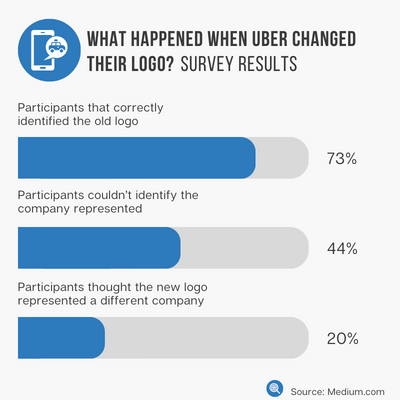
In February 2016, ride-share leader Uber undertook its first major rebrand since the company gained global status. The “bits and atoms” logo was designed to celebrate the technology Uber revolutionized and the cities it serves.  The simple design change should have presented an easy transition for Uber, but one minor detail rendered the redesign unsuccessful and unprofitable, the letter “U.” Similar to McDonald’s golden arches or FedEx’s purple and orange, the “U” made Uber unmistakable. In a survey by Medium, 44 percent of the 2,000 participants could not identify the company represented by the new logo, while 20 percent thought the logo belonged to Lyft or Chase Bank. In the same survey, 73 percent correctly identified the old logo as Uber. One might say it was an uber-tragic situation.

Industry leaders agreed that there were problems with Uber’s rebrand selection.

Crowdspring described the design change as emphasizing “the public’s perception of … hostility, imposing itself on customers with an all-caps, hyper-masculine aesthetic.” Others such as Mark Wilson with Fast Company reflected on the use of UBER as “evoking the members-only corporate club from Uber’s roots as an on-demand black car service for Silicon Valley’s elite.”

By 2018, Uber had undergone rebranding once more. This time, the new logo design simply featured the company name in a custom font over a plain background. And so, it remains to this day.

What Can We Learn From Uber

Uber’s logo rebranding (and re-rebranding) show how easily a simple design change can influence your customers’ opinion of your company. While conceptualizing, designing and implementing the rebranding might have taken a considerable amount of time, it took just an instant for Uber’s target audience to reject it.

In still other cases, long-known industry brands saw renewed success after a brand refresh including DUNKIN’ (formally Dunkin’ Donuts), Lego (now an all-encompassing entertainment brand) and Taco Bell (which underwent a brand ‘”glow-up” in 2016).

Why Should You Rebrand

There are right and wrong reasons to rebrand. Before jumping the gun, make sure your reasons are well-founded and logical. Here are some valid motives to consider rebranding:

1. New location: If you’re expanding to international or culturally distinct markets, it’s best to ensure that your new audience can resonate with your mission, logo, messaging, etc.
2. New mission, vision or values: Every decision your business makes should follow your established mission, vision and values. It’s crucial to reconsider your brand if you detect shifts in your business philosophies.
3.  Market repositioning: You created your brand to connect with a particular customer profile, so if you find yourself repositioning your business to target a new audience, then your brand must also adapt.
4. Mergers and acquisitions: Among the most common reasons for rebranding are mergers and acquisitions. In 2006, Disney and Pixar formed one of the most successful corporate mergers in history. Partnering with Disney propelled Pixar into the world’s most beloved and recognized children’s movie animators. In this situation, rebranding can offer a fresh start for both parties and present a unified front to your audience.

Maybe You’ve Decided Rebranding Isn’t for You

If you’ve decided to stand behind your brand, that’s great! As pivotal as rebranding may be, maintaining brand equity is equally important. Rebrands are not a magic fix and should not be taken lightly. In most cases, establishing a consistent brand identity proves more successful than starting over.

For example, Baker Hughes is experiencing legal troubles after debuting its new helix logo in 2019. Houston-based BMC Software sued Baker Hughes citing similarities between the companies’ logos. While both BMC and Baker Hughes have similar helix logos, the problem stems from the new partnership between Baker Hughes and Microsoft. Now that Baker Hughes is branching out to technology and AI software, BMC argues that the new logo will cause “confusion, mistake and deception, among consumers, the public and the trade.”

The lawsuit shows that a logo rebrand, despite good intentions, can have negative consequences. As expressed earlier, a refresh can be beneficial when your company is expanding its market to attract a new audience, but careful consideration is needed to ensure that the design direction you choose is beneficial for your brand’s future.

Brand equity is vital to a successful organization, and it takes time, money and expertise to build. According to a study by Interbrand, companies that focus on their brand strategy can see a return on investment of up to 300%.

Looking for guidance determining what is the right move for your brand? Our team can help. Whether you want to build brand equity, undergo a brand refresh or feel you need a complete rebrand, we’ve done it all and are ready to put our experience to work for you.

Maybe You’ve Decided Rebranding Isn’t for You

If you’ve decided to stand behind your brand, that’s great! As pivotal as rebranding may be, maintaining brand equity is equally important. Rebrands are not a magic fix and should not be taken lightly. In most cases, establishing a consistent brand identity proves more successful than starting over.

For example, Baker Hughes is experiencing legal troubles after debuting its new helix logo in 2019. Houston-based BMC Software sued Baker Hughes citing similarities between the companies’ logos. While both BMC and Baker Hughes have similar helix logos, the problem stems from the new partnership between Baker Hughes and Microsoft. Now that Baker Hughes is branching out to technology and AI software, BMC argues that the new logo will cause “confusion, mistake and deception, among consumers, the public and the trade.”

The lawsuit shows that a logo rebrand, despite good intentions, can have negative consequences. As expressed earlier, a refresh can be beneficial when your company is expanding its market to attract a new audience, but careful consideration is needed to ensure that the design direction you choose is beneficial for your brand’s future.

Brand equity is vital to a successful organization, and it takes time, money and expertise to build. According to a study by Interbrand, companies that focus on their brand strategy can see a return on investment of up to 300%.

Looking for guidance determining what is the right move for your brand? Our team can help. Whether you want to build brand equity, undergo a brand refresh or feel you need a complete rebrand, we’ve done it all and are ready to put our experience to work for you.

Working Remotely Across Time Zones

Working Remotely Across Time Zones

This July, I celebrated 10 years of working with Foster Marketing. Those years have taken me all over the world to visit clients, walk trade shows, attend conferences and regularly catch up with colleagues. My main base during all this time has been my home in England (first the south, and now the north) while most of the people I communicate with each day are in the U.S., five or six time zones behind me. This means that over the last decade, we’ve all had to adopt a successful, shared strategy of international communication.

I View the Past Decade in Three Phases

Phase 1 (2013-2019): The concept of remote work was in its infancy. Quite simply, not many people did it, and it was viewed by many as the ultimate luxury. I soon found out that the reality of working like this, at that time, was actually quite challenging. Technology and business cultures were not fully developed to support it.

I worked hard to find ways to communicate regularly and effectively with clients and colleagues all over the world. I signed up for international call packages to make long distance phone calls from my land line more affordable. Skype was the go-to medium for my video call into Monday morning staff meetings in the States, but it still felt like a big ask to arrange a Skype call with clients. Recording calls was a headache, as was manual call transcription.

Eventually, WhatsApp came along, making it free and easy to communicate globally by text and share media. Viber became my preferred cellphone app for making free international phone calls. WhatsApp then began to offer video calling, and Viber became obsolete. Towards the end of this phase, the rise of Zoom and Microsoft Teams for video calls began to make international communications much, much easier.

Phase 2 (The “Covid Years,” 2020-2021): The U.S. closed its borders to international travel in March 2020 for one year and eight months, finally opening them again in November 2021. During this time, the video call became king and completely changed mainstream business communication, both internationally and domestically. Fortunately, this was not new to Foster Marketing.

Phase 3 (From 2022 Onward): The present marks a period where there are no longer any significant technological or cultural barriers to international business communications. Working remotely or working from home, at least part of the time, is feasible and normalized like never before.

My Top 10 Tips for Success

However feasible remote work is today, it doesn’t come easy. Here are some of my Top 10 tips for success if you, your colleagues or your clients find yourselves in different time zones or even working remotely from the same time zone:

1. Choose a dominant work time zone, and think in it.
During my working week in England, I think in Houston time. I set my work computer to Houston time to make sure any meeting invites I send out are correct. Whether you’re in a different time zone permanently or temporarily, be prepared to make the mental shift and incorporate it into your lifestyle.

2. Work in chunks of time, not 9 to 5.
You need to live your daily life according to your own time zone, but you also need to make sure your work times overlap with when people in the other time zones are working. For me, this usually means working in chunks of time throughout the day and extending my work day into the evening. A 9 to 5 working pattern is not possible.

3. Commit to a flexible way of working.
There are perks to working in different time zones, including the ability to structure your day in a way that works for you, but there are also the drawbacks of working unsociable hours with late night (or early morning) meetings being common. Commit to taking the rough with the smooth and maintain a flexible approach to your availability.

4. Manage appropriate expectations.
Although it is important to remain flexible, make sure everyone is aware of your general personal schedule so they know what they can reasonably expect from you. If you draw the line at regularly taking calls during your night hours, or cannot attend to emails during certain hours of the day, make it clear that you need to work around these.

5. Be responsive.
When people cannot see you sitting at your desk in the office, it is easy for them to either forget about you or wonder what you are doing, if anything at all. Make sure to reassure people that you are not in bed all day or sipping cocktails on a beach during regular work hours. Regular check-ins communicate that you are available and working, just like they are.

6. Invest in reliable technology.
It is worth investing in dependable, high-quality technology since you will be depending on it so much. Make sure both your computer and phone can handle multiple participant Teams calls, so you can meet while on the road. Also make sure you have a strong connection to high-speed internet to avoid the frustration of dropped calls.

7. Choose your favorite meetings software and have a backup.
Microsoft Teams is the go-to meeting software these days, but it helps to have a backup plan and an awareness of other options on the market (Zoom, Google Meet, or WhatsApp video conferencing) in case there is an in-call issue with your primary one.

8. Switch the video on whenever you call someone.
If you hardly see anyone in person, maximize the time you can make eye contact and see each other’s faces whenever you can. This means not hiding away during video calls. Just a little bit of extra connection can go a long way in strengthening your working relationships.

9. Be mindful of cultural traditions and norms.
Every country has their own way of doing things. For example, they say the U.S. and the U.K. are two countries separated by a common language. But they are also separated by diverse norms, customs, holidays, work styles and general communication styles. Spend some time considering these differences and how best to be respectful of them.

10. Meet in person whenever you can.
Simply nothing compares to meeting in real life, so even though remote meetings are the new normal, don’t stop visiting and traveling to see people in their offices as often as you can. Not only does it improve overall business relationships, but it’s also a whole lot more fun than sitting alone at your desk!

Whether in the United States or abroad, if you need marketing support, contact Foster Marketing’s international team of experts today. Call us on 281-448-3435, contact us online or connect with us on LinkedIn.

 Foster Marketing’s founder George Foster and Anna Scordos-Brooke celebrate her 10th anniversary at Foster Marketing with a 10-year-old bottle of wine in Lancashire.

While chasing down the next big article and traveling to meet with clients, Anna has landed some great stories of her own!

A Mid-year Look at Social Media Trends of 2023

A Mid-year Look at Social Media Trends of 2023

Welcome to 2023: TikTok, 5G technology, BeReal, Macro-influencers … the list goes on. They seem like mere buzzwords, but it is really the world of social media. And, it is hard to deny that social media impacts your everyday life, whether you want it to or not.

The good news? Platforms such as TikTok, Facebook and YouTube can be powerful marketing stages for your brand to connect with your clients or potential customers. It is crucial for your company to understand current social media trends and how to use these platforms to their peak performance.

According to the Forbes Advisor, an estimated 4.9 billion people use social media across the world in 2023, and this number is expected to jump to approximately 5.85 billion users by 2027.

Where Should Your Company Be?

While LinkedIn is likely going to be your bread and butter for business, it is important to know which social media platforms are getting the most monthly active users. Facebook currently continues to dominate as the most visited social media site in America. Its successor? YouTube; with 2.5 million monthly active users.

Time is … Precious?

The average person spends about 145 minutes on social media every day. If the average person maintained this usage over an average life span of 73 years, the result equates to 5.7 years spent on social media platforms. Why not maximize the potential of an effective social media strategy for your company when stats like these exist?

What’s Working on Social Media?

You have probably heard our team preach about the power of video. The numbers do not lie!

Short-form Videos

Videos typically less than a minute in length are winning on social media, capturing the attention of 66% of consumers. These snippet-like videos are 2.5 times more engaging than longer videos. They are easily shareable and the most engaging type of content that is both authentic and concise.

Tapping In

Most people are checking in on social media through their mobile devices, with 99% using a tablet or smartphone, and 78% of those checking in exclusively from their phones. It is key that you flex your social media strategies and website so that form fits function. Plan out social media calendars and build your websites for both desktop and mobile experiences.

Best Times to Post on Social Media

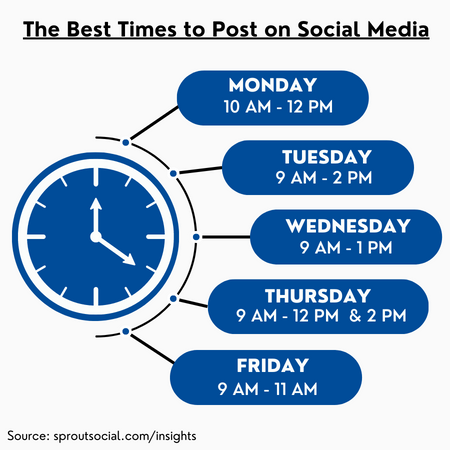
Knowing the best days to get the most engagement on social media will set you up for success. Here is how you should prioritize, according to Sprout Social:

While Tuesdays through Thursdays between 9 a.m. and noon are generally the best times to post on social, it is important to consider all external factors for your social success.

It Is Never Too Late to Get Started!

At Foster Marketing, we are consistently looking for ways to improve the social media presence and overall brand of our clients. Social media trends are transforming daily and what might be trending one week is not the next. Our team is here to stay in-the-know for your company. Call Foster Marketing today to talk trends and beyond! You can also contact us online or connect with us on LinkedIn.

What Draws Attendees to Your Trade Show Booth?

What Draws Attendees to Your Trade Show Booth?

There are a few marquee companies today that only need to register as an exhibitor, set up their booth and everyone will visit. The challenge for everyone else is creating that unique experience that will draw customers into their company’s booth. Here are three fresh examples from the first half of this year’s tradeshow circuit that put a spotlight on these exhibiting companies.

Personalizing the Lunch Sponsorship

Does anyone from your team cook award-winning barbecue? ValTek parlayed their award-winning barbecue from the 2022 Daniel Energy Barbecue competition into a lunch sponsorship at the 2023 Thrive Conference. This was no ordinary lunch sponsorship. ValTek’s team cooked overnight in their outdoor booth and personally served free lunch to all exhibitors and attendees at the conference.

This complimentary lunch brought more than 1,200 people to their booth. There’s no better way to show everyone your team’s work ethic and professionalism than to cook overnight and have them pick up their free lunch from you next to a product in your booth. This example of personalizing a sponsorship could be used with multiple other traditional methods such as handing out show-sponsored lanyards or brochures. Speak to your conference representative about a sponsorship that can show your company’s personality.

Customizing Can Change the Game

If you’ve been to at least one or two trade shows you’ve either seen or tried your skills at a putting contest on a regular putting green. If you are like me, after a few times the putting contest stopped drawing your attention. For IFPE this year Dura-Bar wanted to make the putting contest exciting again. They decided to customize their booth’s putting green by getting a 3-hole putting green built in the booth with a contouring green, fringe and sand traps. This really grabbed the attention of the attendees and had people lining up to test their skills. To take it further, Dura-Bar used their cast iron material to make putters that were given to the winners of the putting contest. Dura-Bar showed that customizing a staple attraction at trade shows can make your booth the talk of the show.

Using Ingredients as an Incentive

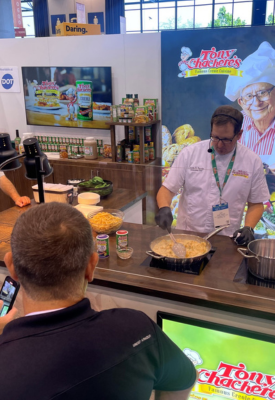
They say food is not for just eating. It should be an experience. Well, this year at the National Restaurant Association show, Tony Chachere’s whipped up some delicious culinary creations to entice visitors to experience their trade show booth. People’s interests were piqued when the Tony’s team had a corporate chef making shrimp and grits, pastalaya, and more meals for exhibitors and attendees to sample throughout the day. With a custom-built kitchen setup, this tactic produced a personal ambiance to accompany some classic home cooking.

Not only does this method allow visitors to try out the product first-hand, but it generates a memorable time that is easy to recall when thinking about the trade show. At the same time, when attendees walk around the show with their food samples, it creates a word-of-mouth movement to get more visitors to the booth. It also stood out to those who take a special interest in cooking. During the cooking demos, they can discover different ways to use the product while gaining insight from a professional chef.

What attraction can you put a fun twist to in order to draw attendees to your company’s booth? Here are a few other trade show booth draws that we have had success with over the years:

  • Artists
  • Chair massages
  • Simulation screens
  • Trivia
  • Afternoon whiskey tasting
  • Cookies or popcorn (it’s the smell)
  • Cigar rolling
  • And, a shoe-shine station!

These great ideas show that there are always opportunities to make an impact on the show floor no matter how big or small your company is. Fall and spring are the most popular times for trade shows. For more great ideas like these, call Foster Marketing.