tsoileau@fostermarketing.com
Dustin Ponthieux Named Event Manager at Foster Marketing

Dustin Ponthieux Named Event Manager at Foster Marketing

Foster Marketing, a full-service marketing communications firm serving the global energy and industrial sectors, has promoted Dustin Ponthieux to event manager.

Ponthieux will be responsible for coordinating and managing trade shows and client events in the U.S. and overseas. Prior to joining Foster in 2021, Ponthieux coordinated more than 250 events for Oklahoma State and Ragin’ Cajuns athletics programs. Ponthieux also served as a Marine Corps Security Guard at the U.S. Embassy in Qatar, Singapore and Russia.

Foster Marketing’s president and CEO, Tiffany Harris, said, “As a native of South Louisiana and based in Houston, Dustin is no stranger to the energy, industrial and utility industries and brings a can-do attitude and energetic approach to his work. Dustin provides a high level of detail and agility to the planning and implementation of each event, giving our clients peace of mind and an earned level of trust.”

Ponthieux said, “I have enjoyed, and learnt a great deal from my experiences in event management in the last few years, and I look forward to tackling the challenges and enjoying the successes with our event clients through 2024 and beyond.”

Ponthieux holds a degree in business marketing with a minor in international business from the University of Louisiana at Lafayette.

The Key to KPIs

The Key to KPIs

KPI seems to be the latest buzzword making its way across boardrooms and project updates. Maybe it’s because budgets are being more heavily scrutinized so marketers feel they need to prove the value of every spend. Maybe it’s because more people are still working remotely so we now live in a land of shareable dashboards. Maybe it’s that the digital tools we are using seem a bit savvier with the recent AI push. Hopefully, it is because business leaders are looking to amp up their game and are planning to use KPIs to create their playbook.

Key performance indicators (KPIs) can be a lot of things, including strategic, operations-focused, company-wide, department/division-specific, looking back or predictive. What they are not is a one-size-fits-all method of reporting wins. Strategic marketing goals, business objectives, timelines and audience targets are unique, so pulling a set of KPIs off the web will be neither key nor indicative for your company. Instead, your company’s KPIs should be, like it says, key to your company. And, setting a company’s KPIs should not be something done once and then forgotten. Just as your company goals change, so should your KPIs. So, where should you start? Here are some suggestions.

Setting Your KPIs

First, take a look at your organization and its needs. How do people use information? If your team receives monthly reporting and never spends the time to review it or it doesn’t offer any value to them when they do view it, consider keeping your KPIs clean and simple and present them in a highly visual, 5-minute review format. On the other hand, if your team lives for the four-mile-long spreadsheet delivered to their inbox each month that shows every cent won and lost, your KPIs can likely be more complex and presented with a greater depth of data.

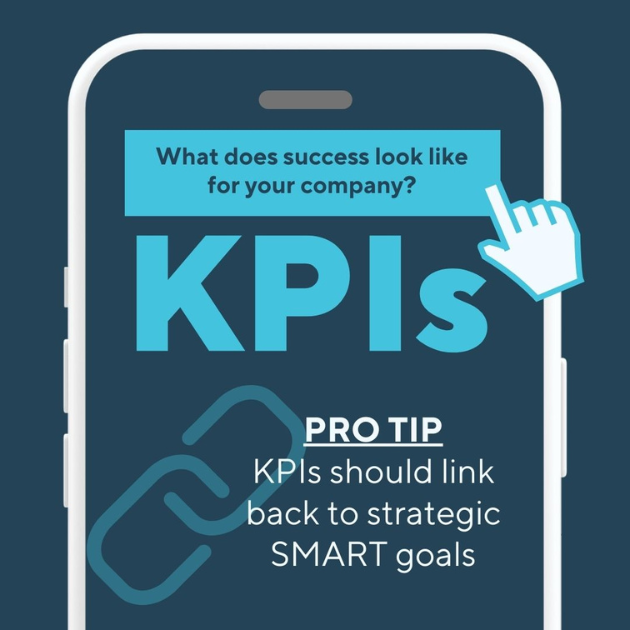
Second, and this is the most important step, pull out your strategic goals, likely for the upcoming quarter. Assuming you have SMART (Specific, Measurable, Attainable, Realistic, and Time Specific) goals that you are working toward, your KPIs should pair with these deadline and quantitative goals. Reminder: not everything can be key, so you should keep your list of KPIs to a reasonable amount.

Third, determine how you will consistently track these identified KPIs. Note, you must be able to track each KPI over time using the same method to get a clear picture of trending. Then, determine how you wish to show and share these performance indicators and how often (i.e. monthly, quarterly, or yearly).

Finally, and here is the step often forgotten, decide who will take ownership of managing actions based on KPI outcomes. For example, often we see trends sliding downward indicating action is needed. A champion needs to be assigned to get the ball rolling on adjusting your goals and KPIs or evaluating what action needs to be taken to improve performance quickly.

Other KPI Methods

If you are so focused on day-to-day operations that you don’t have time for big-picture thinking, build time in your schedule immediately, but in the meantime, you can set operational KPIs. These usually focus on sales pipeline or customer engagement data. For example, you could monitor the number of meetings set per week, the number of bids submitted, the number of new sales per month, total sales revenue or satisfactory customer service surveys. Many of these KPIs come pre-baked into tools such as HubSpot. You can also focus on engagement factors such as open rates on emails, surveys completed, and social media likes and followers.

More than Win and Loss Reporting

Qlik, a company that works in complex data landscapes to bring about strategic outcomes for businesses, suggests using a mix of lagging indicators and leading indicators in KPI planning. A lagging indicator shows you what happened in the past but a leading indicator can help you make educated predictions on what could happen. For example, a lagging indicator might be the percentage of users who clicked a button on an online ad campaign in the past quarter. A leading or predictive indicator might be a decline in the number of mobile users on your sites last quarter, for example, which could significantly impact your plan to launch a mobile product training academy next quarter.

Investopedia illustrates this difference, noting that leading indicators help you forecast or predict future movements and actions while lagging indicators show you the results of what happened based on your previous actions. Considering your KPI data in both such manners can help you be more strategic in your marketing communications planning, from selecting the channels to use to deciding which content generation activities you commit time, talent and spend t

Key Takeaways

  • Change how you look at and use KPIs (and your general reporting) to make these efforts more about informing your future actions and seeing the impact your efforts made versus only showing wins to justify the spending.
  • Company A’s KPI will not be the same as Company B’s, even if they are in the same industry, geographic market, etc.
  • Link KPIs to your strategic planning and SMART goals.
  • Re-evaluate your KPIs quarterly to see if other indicators are more key to your organization today.
  • Avoid KPI overload, especially if too much data makes your team delete your emails. Be brief, specific and visually display data when possible. Consider making your KPIs fit on a single page so a viewer can get a good feel for what’s happening in 5 minutes or less.
  • Be consistent with your KPI reporting. This is big. Four people can show a key piece of data in four different ways. Make sure you track KPIs using the same method, over the same period, no matter who generates the reporting.

Need help crafting your KPIs and determining your next steps based on these indicators? Call the Foster Marketing team today at 281-448-3435 or contact us via our website.


That’s a Wrap for 2023

That’s a Wrap for 2023

In December, it is always fun to look back and reflect on the past year. We relive the wonderful memories made, enjoy the accomplishments and walk away with a new perspective for the coming year.

As we share a look back at 2023, through the eyes of our team, we hope you can find as many things to be thankful for and embrace all that 2024 will bring.

Merry Christmas from our family to yours, and many blessings for a prosperous new year!

So, if your to-do-list for 2024 is a little overwhelming, our team of marketing professionals is just a call or click away. Let us be your proactive partner, help accomplish your goals and then track your success. Call 337-235-1848 or email us.

Favorite Recipes From Our Foster Family

Favorite Recipes From Our Foster Family

Gathering, sharing, laughing, watching football … all parts of a perfect Thanksgiving celebration. But, we all know the real star is the food! Appetizers, treats, sides and desserts all support the main course and we are here to share our favorites with you!

Our team had fun gathering these recipes and we hope you enjoy making them as much as we do!

Download the Foster Marketing Cookbook with some of our holiday favorites, including:

George’s Holiday Favorite – Maque Choux

Natalie’s Winter Comfort – Slow Cooker French Dip

Tori’s Cup of Joy – Crockpot Chicken and Gnocchi Soup

Dustin’s Low Calorie Comfort Food – Quick Corn and Shrimp Soup

Elaine’s Mouthwatering Tacos – Crockpot Birria Tacos

Gary’s Steal the Show Entrée – Bang Bang Shrimp

Kelsey’s Praised Party Favor – Spinach Artichoke Dip

Megan’s Out-of-this-world Dip – Corn Dip

Tiffany’s Holiday Helper – Wassail

Kristy’s Dessert Hack – Easy Apple Turnovers

Katie’s Pick-me-up – Coffee Bundt Cake

Gage’s Family Favorite – Chocolate Delight

Darlene’s Delicious Dessert – Chocolate Éclair Cake

Anna’s Decadent Delight – English Banoffee Pie

Tiffany’s Sweet Addiction – Toffee Chex Mix

>> Download Full Cookbook!

Happy Thanksgiving from our Foster Family!

Mastering Growth: A Guide to Crafting an Effective Marketing Budget and Strategy for 2024

Mastering Growth: A Guide to Crafting an Effective Marketing Budget and Strategy for 2024

If you’re like us, you might have blinked and realized that this year is coming to an end! With the new year approaching rapidly, it’s time to start planning for 2024. What kind of growth do you envision for your business? How can you attain these goals? Where should you begin?

As long-time marketing strategists, we understand the stress that comes from planning for the future – especially with the persistent ticking of the clock in your mind. Navigating the complex terrain of marketing budgeting and strategy can be a daunting task, often accompanied by the relentless pressure of making the right choices promptly. This article aims to equip you with a guide for creating an effective marketing budget and strategy that empowers your business to survive and thrive in today’s ever-evolving market landscape.

Planning for the Future, Understanding Market Conditions

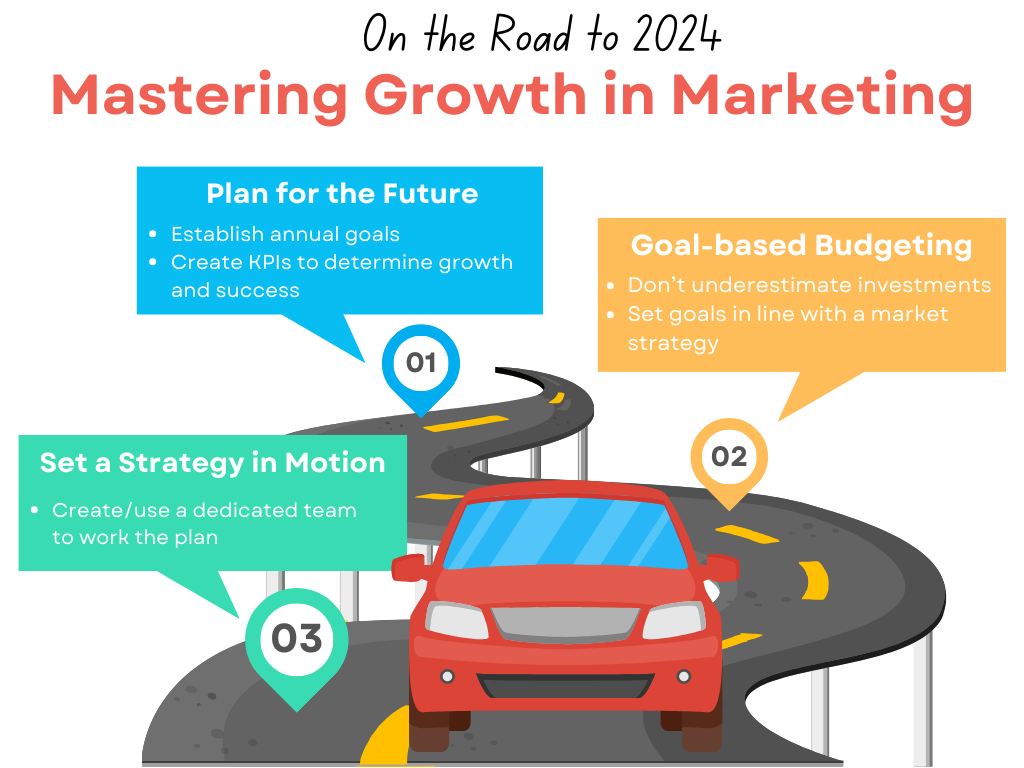
Establishing annual SMART goals and objectives for your business forms the foundation for crafting an effective marketing strategy. But understanding the ever-changing landscape of the industries you serve will allow you to develop a marketing plan and budget that allows for sustainability and flexibility – remember that we must always be ready and able to pivot when necessary. A few questions to ask yourself to get started:

  • What trends are we seeing in the industries we serve – market conditions, competitor analysis, geographic focus, etc.?
  • What are our growth goals and objectives – company and product specific, short and long term, geographically? (TIP: Get very granular with this one! Ultimately, the overall goal of any company is to increase revenue and net profit … knowing your financial status and understanding the industry climate will help you to assign growth percentages that are attainable.)
  • Where do I see the growth coming from – new products and services, M&A opportunities, diversified markets, general new business development, etc.?

Now it’s time to break down your due diligence into digestible pieces using key performance indicators (KPIs).

KPIs are brand-specific objectives used to steer your business toward your goals. Think of your annual goal as a cross-country road trip – KPIs are the pit stops and scenic views you visit along the way. Once your road trip is planned, you can begin your journey to your first pit stop. Your experience with your first KPI should dictate the next goal that you set.

Here are a few examples of marketing KPIs:

  • Big picture KPIs:
    – Launch X products/services in 2024.
    – Overtake competitor X in market share by Q2.
    – Increase company EBITDA by X percent by Q3.
    – Identify X M&A opportunity(s) in 2024.
  • Marketing initiative KPIs:
    – Increase organic website traffic by X percent in Q1 (TIP: Selecting a challenging but achievable goal is best).
    – Obtain X executive interviews in X publications by Q3.
    – Boost brand awareness by gaining X social media followers per month.
    – Attend X industry events, capturing a minimum of X post-event new business meetings per event.

With your annual SMART goals and KPIs identified, it’s time to shape and mold your marketing budget.

Goal-based Budgeting

The number one mistake businesses make while planning their annual marketing budgets is underestimating their investments. If your goal is to grow your business by X amount, but your marketing budget only covers a bulk order of branded pens – you will be disappointed. The old adage, “you have to spend money to make money,” is true … but if you spend and invest properly, you do not have to break the bank to see results.

Overcompensating your marketing budget will lead to a negative return on investment (ROI). This LinkedIn article showcases a simple strategy to help develop a targeted and maintainable marketing budget to fit with your growth goals:

Goal 1: Maintain market position.

  • Allocate 1-2% of your top-line revenue to engage and retain current customers with simple strategies.

Goal 2: Increase market share with moderate growth.

  • Allocate 3-4% of your top-line revenue to attract new prospects and retain current customers with advanced strategies and tools.

Goal 3: Ambitious growth.

  • Allocate 5% or more of your top-line revenue to accelerate results with complex strategies and tools.

Marketing spend across industries can look vastly different. In this HubSpot article, check out the percentage of revenue used in marketing budgets for various industries, according to survey results. If you are looking for benchmarks for budgeting, take a look. Of special interest on the list are: energy, manufacturing, mining and construction, technology and transportation. >> Check out this article noting marketing spend by industry.

Set Your Strategy in Motion

Now that you have outlined your goals and developed an investment plan, it’s time to implement your marketing strategy! To ensure the successful realization of your business goals, it’s crucial to surround yourself with a team of dedicated marketing professionals.

If you require assistance in developing and executing a marketing budget and strategy for your business, get in touch with Foster Marketing today! With nearly 44 years of experience, our strategic thinkers are here to help you through your New Year’s transition and beyond!

Connect with us to discuss your plans for 2024.