tsoileau@fostermarketing.com
How Tidy is Your CRM? Cleaning Up Can Spark Joy

How Tidy is Your CRM? Cleaning Up Can Spark Joy

A Customer Relationship Management (CRM) system should make your customer and prospect management efforts easier, not more difficult. If you find the latter is true for you – or you don’t even have a system in place, it may be time to consider some CRM spring cleaning or a new addition to the marketing mix.

What should a CRM do? Simply put, a CRM – such as HubSpot, Zoho, SaleForce, Pipedrive or Monday Sales CRM – should track interactions with customers and prospects throughout the sales cycle, help you stay connected to these key audiences, create efficiencies throughout the sales cycle, enhance the flow of information between new business and sales, store all key data on these efforts and improve profitability. If you are in new business or sales, a CRM should help you get to the work that makes an impact, like engagement with customers, instead of spending most of your day sorting through notes, spreadsheets and emails. Just like your garage or any storage area, an unmanaged CRM can get out of control and be less of a time saver and more of a time suck. If this is where you are, we suggest going back to basics by focusing on what your CRM is supposed to do for you.

CRM platforms help us accomplish many tasks, but at their core, they are about relationships. By understanding your primary goal for using a CRM platform – and how your CRM systems should help you better manage customer relationships – you will be able to take the next steps to clean up or replace your current platform.

Focus on The Essentials Your CRM Must Accomplish First

Centralize data: CRM systems can be used to store customer data in one centralized location, including contacts, interactions (such as emails, phone calls and meetings), purchase history, preferences, permission to email and other relevant details.
Interaction tracking: CRM systems can be used to track customer interactions across various channels including website, email, social media engagement and phone calls to provide visualization of a customer’s journey.
Automation: CRM systems often give an option to automate tasks such as sending emails, scheduling appointments and generating reports.
Manage sales pipelines: CRM systems often offer sales pipeline management, tracking leads, forecasting sales or analyzing sales performance.
Analytics and reporting: CRM systems can also provide customer insights such as customer behaviors, preferences and trends in custom dashboards and reports.
Integration: Modern CRM systems offer integration opportunities to streamline efforts such as follow up emails, proposals and quotes, social media management, lead-generation, email marketing and even inventory system integration.
A CRM system can be a powerful tool for your business if it is well-maintained and set up to meet your company’s needs. After you assess your company goals and make sure your CRM is set to support this effort, it’s time to look at your data to see if cleaning is needed.

Consider your data in the CRM and determine if any cleanup or reorganization is needed for efficiency or to improve customer engagement. Also, it may be time to purge files with no activity or those who are not valid customers or prospects. It is easy to allow sales offers to sneak into your data if your website forms are directly connected to your CRM system. Cleaning up your data will help ensure you’re not wasting time emailing the wrong people. Additionally, many CRM platforms charge based on your number of records, so tidying up your data could save you money.

  • Consider deleting records with:
  • Duplicate contact entries
  • Invalid emails
  • Contacts with no reply email addresses – group emails such as info@mycompany.com
  • Fake or spammy emails
  • People trying to sell you something
  • Data errors
  • Contacts not active (haven’t engaged with your web or content) for more than two years (we advise two years as many B2B customers have longer term sales cycles)

Reorganize Your Data for Success

Consider adding a priority system such as lead scoring to your CRM system to hyper focus your efforts and goals.
Tagging for better audience targeting can let you send relevant messages to your specific prospects in specific industries or areas.
Take your cue from Marie Kondo if your CRM system isn’t sparking joy currently and tidy up.

Declutter for complete clarity: Just as decluttering your home brings clarity and a feeling of order, cleaning up your CRM eliminates outdated, redundant and irrelevant contact records.
Organize for efficiency: Organizing at home saves time and reduces stress. Similarly, organizing your CRM data saves time and improves efficiency in business operations.
Accuracy: Keep what is working but clear out inaccurate information.
Revitalize: As you re-evaluate your contacts, take this opportunity to re-engage with customers you haven’t heard from in the past several months.
Plan to check in: Just as cleaning is considered a continuous process, so is maintaining a clean CRM. Regularly reviewing and updating your CRM ensures that it continues to support your business goals. We suggest adding this task to your calendar to ensure it doesn’t fall through the cracks. A monthly declutter hour can do wonders for your data.

With a clean CRM and your prospect list re-organized, you are better positioned for success in your upcoming targeted marketing efforts. Ready to add some joy to your marketing efforts? Call us at 281-448-3435 or contact us today.

Did you know that 54% of salespeople who participated in HubSpot’s 2024 State of State Report said selling got harder in 2023? 

Only 30% of salespeople who participated in HubSpot’s 2024 State of State Report said their sales and marketing teams are strongly aligned, but 61% said this alignment is more important now than it was last year. This alignment can be attributed to using a CRM system to its complete potential. 

Hey Siri … How Important is Voice SEO to My Business?

Hey Siri … How Important is Voice SEO to My Business?

Have you ever noticed how many popular “futuristic” science fiction movies from the 20th century are now set in the past? Take, for instance, scenes from “Back to the Future Part II,” which are set in 2015, or “Blade Runner,” set in 2019. While the technological advancements depicted in these movies haven’t materialized exactly as predicted, where is my flying car? – it’s crucial to stay at the forefront of the ever-evolving tech landscape to ensure your business doesn’t stay in the past. 

One common science fiction theme that many movies did get right is the integration of Artificial Intelligence (AI) voice assistants in our daily lives. While Siri, Google Assistant and Alexa have inched their way into our phones, cars and homes, it’s important to recognize these voice assistants’ impact on your business’s online visibility.

You might think, “Well, my business is already leveraging SEO techniques to improve Google rankings; voice assistants shouldn’t change that.” However, this line of thinking could be detrimental to your business in the long term.

Hey Siri, OK Google, Alexa and Beyond: The Rise of the AI Voice Assistant

Since then, we’ve witnessed rapid growth in artificial intelligence that shows no signs of slowing. This growth spurt eventually led to the development of the first AI voice assistant, Siri, in 2007. In 2010, Apple acquired Siri and debuted the world’s first mainstream AI voice assistant with the release of the iPhone 4S in 2011. Siri changed how the world interacted with smart devices and began a new stage in technology, the constantly evolving technological revolution, introducing virtual companions into our daily lives.

Why Voice Search Matters for Your Business

Voice search has experienced growth in recent years, with more users turning to their AI assistants to find information quickly. According to a study by UpCity, 50% of consumers used voice search daily in 2022. This trend is only expected to accelerate, making it imperative that businesses ensure their online presence is optimized for this shift in search behavior. So, why is optimizing your business website for voice search so crucial?

Changing Search Behavior

The way people search for information online is evolving. Unlike traditional text-based searches, voice searches are more conversational and natural. Users are more likely to ask questions or phrase their queries as they would when speaking to a person. Therefore, websites must anticipate and cater to these conversational search queries by incorporating relevant long-tail keywords and phrases into their content.

Enhanced User Experience

By optimizing your website for voice search, you’re not only improving your chances of being discovered but also enhancing the overall user experience. Voice search technology enables users to access information hands-free and conveniently, leading to higher engagement and customer satisfaction. By providing accurate, relevant answers to voice search queries, you’re positioning your business as a trusted authority.

Competitive Advantage

Early adopters of voice search optimization stand to gain a significant advantage over their competitors. Businesses that are optimizing their websites for voice search avoid falling behind the curve. By staying ahead and embracing emerging technologies, you can position your business as a leader in your industry and attract more leads.

Preparing for the Future

The prevalence of AI assistants and the use of voice search is expected to increase in the coming years. By optimizing your website now, you’re future proofing your business and ensuring its relevance to future users. By understanding the changing nature of search behavior, focusing on local SEO, enhancing the user experience, gaining a competitive advantage and preparing for the future, businesses can unlock new opportunities for growth and success. Embrace the power of voice search optimization today and pave the way for a brighter future.

If you’re searching for a marketing agency to boost your business’s online presence through voice search optimization or more information, contact Foster Marketing at 337-235-1848 or visit fostermarketing.com.

According to Tableau, the 1950s marked the birth of AI.

Fostering-Ideas-Timeline (2).png

Cassidy Whitaker Named Marketing & Analytics Coordinator

Cassidy Whitaker Named Marketing & Analytics Coordinator

Foster Marketing, a full-service marketing communications firm serving the global energy and industrial sectors, has named Cassidy Whitaker as marketing & analytics coordinator. Whitaker will be responsible for supporting account, digital and tracking efforts with a specific focus on showcasing results and applying data insights to strategic marketing campaigns.

Whitaker holds a degree in marketing from the University of Oklahoma. Before joining Foster Marketing, Whitaker displayed strong performance as an intern for a large energy industry company. As Foster Marketing’s marketing & analytics coordinator, Whitaker will draw upon her previous experience in digital marketing including social media, tools such as SharePoint and analytics result-reporting efforts.

Foster Marketing’s vice president of account services, Megan Schreckenbach, said, “Our clients and team can make strategic marketing decisions in areas such as audience targeting through data-driven reporting. We are excited to add Cassidy to our team to help us better capitalize on and react to what the numbers are telling us.”

Foster Marketing’s president and CEO, Tiffany Harris, said, “At Foster, we are always looking ahead to ensure our clients are best able to position themselves in the markets they serve and moving toward their key performance goals. Cassidy will be a key player, working with our digital and account teams to ensure we track and pivot based on result reporting measures.”

The Changing Role of the News Release

The Changing Role of the News Release

What’s in a name?

There are minor differences between a ‘press’ release and a ‘news’ release. For instance, a press release typically foretells future events, whereas a news release generally focuses on ongoing or past occurrences. Press releases are commonly linked with traditional news channels, while news releases are a more modern incarnation and better suit online communication.

While press releases target the press specifically, news releases cater to broader audiences. Some argue that ‘news release’ is a more relevant term than ‘press release,’ with ‘media release’ also gaining popularity. Ultimately, the essence and purpose of a press release, news release, or media release are similar, but for the sake of argument, let us use ‘news release’ as our catch-all term.

Serving a purpose

News releases are designed to serve as a vehicle for brands to craft compelling narratives and share newsworthy updates with journalists, bloggers and influencers. Whether announcing product launches, corporate milestones or industry insights, news releases offer a structured format for delivering key messages and shaping public perception.

By adhering to journalistic standards and providing accurate and timely information, companies can foster trust and goodwill among stakeholders, including customers, investors and the public. When issued by reputable organizations such as Foster Marketing, news releases serve as a stamp of authenticity, lending credibility to the information conveyed.

There was a time when news releases held significant sway on their own, acting as the linchpin of public relations strategies. However, their role has since undergone a transformation. Today, news releases constitute just a single component of a multi-dimensional public relations endeavor.

Each piece of content has a part to play

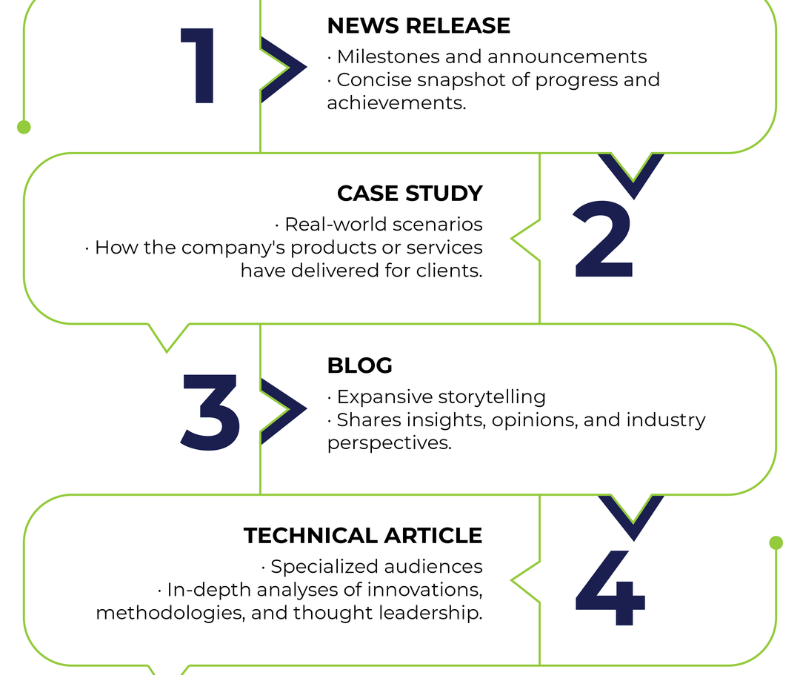
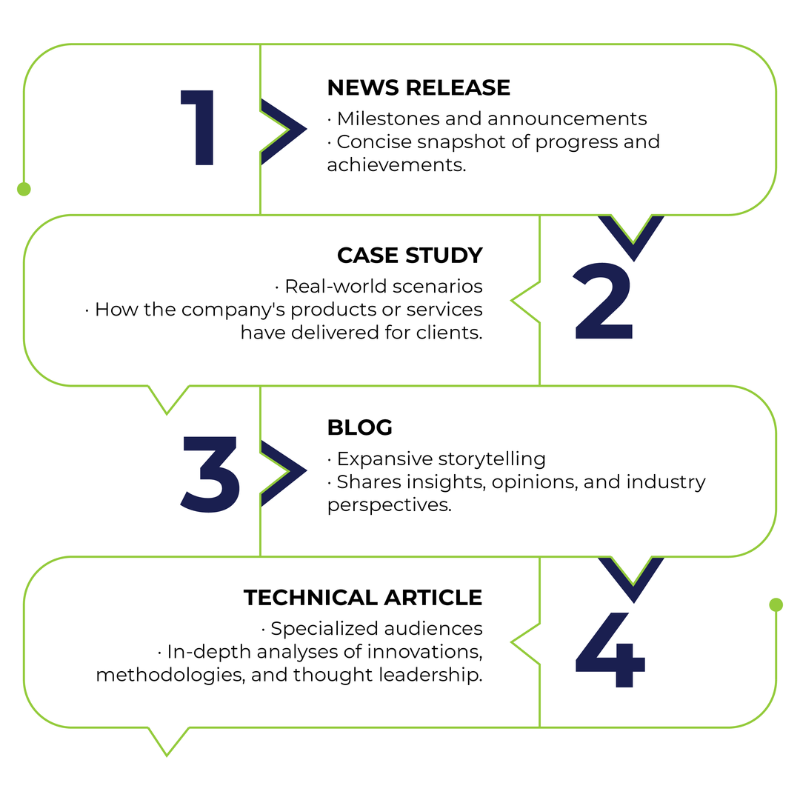
Every communications medium used in a public relations campaign offers a unique lens through which the company’s story can be told, catering to different audiences and objectives while contributing to a rich and multifaceted narrative:

A news release distills essential milestones and announcements into concise, newsworthy updates, presenting a snapshot of the company’s progress and achievements.

A case study delves deep into real-world scenarios, illustrating how the company’s products or services have addressed specific challenges and delivered tangible results for clients.
Blogs offer a platform for more expansive storytelling, allowing the company to share insights, opinions and industry perspectives, while social media posts provide bite-sized glimpses into daily operations, company culture and community engagement efforts.
Technical articles cater to specialized audiences, offering in-depth analyses of the company’s innovations, methodologies and thought leadership in their respective fields.

Like all the other components of a PR campaign, news releases are not designed to work on their own. Rather, they play a helpful supporting role in the overall PR push for a company.

The news release’s supporting role

As well as their primary role of sharing factually correct promotional information about a company, news releases can help improve a company’s search engine ranking and attract organic traffic to its website by incorporating relevant keywords and links. In the age of social media dominance, news releases complement companies’ digital marketing efforts by providing shareable content for social platforms.

By repurposing news release content into engaging social media posts, companies can amplify their reach and engage with audiences in real-time. Additionally, social media platforms serve as distribution channels for news releases, enabling direct engagement with journalists, influencers and industry insiders.

A gateway to visual storytelling

As attention spans dwindle and visual content gains prominence, news releases are embracing multimedia formats to capture audience attention. From embedded videos and infographics to high-resolution images and interactive elements, multimedia-rich news releases offer a dynamic and engaging user experience. By leveraging visual storytelling techniques, companies can convey complex information more effectively and leave a lasting impression on their audience.

The pr snowball effect

A well-crafted news release can serve as a springboard for generating a myriad of editorial opportunities. Journalists often use news releases as a source of inspiration for in-depth technical articles, exploring the intricacies of a company’s innovation or industry trends. Case studies mentioned in news releases provide compelling real-world examples that journalists may seek to turn into feature articles that showcase the practical applications of a product or service.

Additionally, news releases announcing executive appointments or corporate initiatives can spark interest in conducting exclusive interviews or Q&A sessions with company executives, providing valuable insights and perspectives for editorial content.

In essence, a well-crafted news release not only disseminates news but also serves as a catalyst for generating a wide array of editorial opportunities that contribute to building brand visibility and credibility. This is what we at Foster Marketing call the ‘snowball effect,’ and it is the main reason we advocate the use of news releases in a diverse and effective PR campaign.

Summary

While their role has evolved over time, from being the linchpin of PR campaigns to serving as a supporting element within a broader communication framework, news releases continue to play a vital role in shaping public perception and building credibility. By integrating with other storytelling mediums and leveraging multimedia formats, news releases enable companies to tell their stories in diverse and engaging ways, catering to different audiences and objectives. Moreover, the “snowball effect” generated by well-crafted news releases amplifies editorial opportunities, further enhancing brand visibility and credibility in the eyes of the public. To create that “snowball effect” call Foster Marketing at 337-235-1848 or contact us online.


Is Your Business Efficient?

Is Your Business Efficient?

Business efficiency shows how effectively a company creates products and provides services relative to the amount of money and time required to make this happen. Simply put, it illustrates the relationship between output and input.

The goal, of course, is to maximize your outputs while minimizing your inputs. To be successful in this formula and in business, you must make the most of your existing resources – be that technology, tools or talent.

Does making an effort to evaluate where you are today and make a plan to improve efficiency seem like a waste of time … or just more busy work that sucks from your time each day? A business that improves its efficiency reduces waste, creates higher profits, builds a more productive – and satisfied – team members and even more satisfied customers. See your key goals on this list? Then read on for where to start evaluating your current efforts and making positive changes.

Here are some ways a business can improve efficiency:

  • Provide the right tools: This could be new software or a training program for employees. These may pay for themselves as a result of improved sales or productivity. At Foster, we highly encourage testing out new tools to allow team members to better collaborate, brainstorm across multiple offices and track and share wins. Within the past year, we’ve implemented at least three platforms that are hitting all of these marks.
  • Know what to cut: Analyze your processes and operations and look for ways to reduce complicated or redundant processes or procedures. In an Artificial Intelligence (AI) powered world, automation is a powerful tool to leverage. AI can streamline everything from typing your voicemail and meeting notes to sending out weekly and monthly reports.
  • Delegate: Don’t put too much work on too few people; spread the work around. Again, tools that help teams collaborate may be the answer here. Also, training is key so your backups have backups. At Foster, we hold Brown Bag sessions where staff can request training on a topic and all are invited to attend. Through this effort, we’ve quickly increased our depth of knowledge by four (4) times.
  • Shorten your meetings each week: Make them focused and to the point. Overly long meetings cut into productive time. Sometimes, a quick 10-minute touch base can be just the thing to keep a project moving. Or, maybe a 30-minute download on all team efforts is a better fit. Perhaps an online real-time project management solution is better to eliminate a few meetings each week. In general, keep your team’s needs in mind, and if meetings are causing stress because you do not have time to actually work, try a new approach.
  • Reduce multitasking: Give employees uninterrupted time to focus on one task at a time. At Foster, admittedly, we do a lot of multitasking because that is how we are wired. However, for detailed project work, our team has the freedom to safeguard time slots in Outlook to focus completely on projects. This not only allows our team to do their best work, but also, they are more productive because they have some control of how they will hit deadlines. Also, we highly value think time, allowing our team to ponder new solutions for us and our clients.
  • Keep morale high: Make your employees feel that they are valued by the company. Provide constructive feedback and reward employees for a job well done. Foster has always put an emphasis on this, whether it is through growth opportunities, profit sharing or perks … like hosting our corporate meetings on a Thursday and Friday in sunny Mexico so our team gets a fun-filled tropical weekend.

Want to jump start a team or personal training effort this week? Growing certain business skills is an important part of a company’s overall efficiency. Here are some key growth areas for developing your business skills that may be worth spending time on in the near future.

Visit LinkedIn Learning and do a search for more of the following – or just do a Google search – and jump in.

  1. Time management
  2. Team-building
  3. Analysis
  4. Negotiation
  5. Problem solving
  6. Sales and marketing
  7. Financial management

These skills are a fundamental component of operating and managing a successful business. Cultivating these skills personally and within your team will help increase productivity and profits, maintain a positive company culture and build and maintain a strong customer base.

Want a quick way to make your marketing efforts more efficient? Call Foster Marketing today to get us onboard to create an integrated marketing communications plan and watch the action items being checked off your list. Call us at 281-448-3435 or email us today.

Here are some ways a business can improve efficiency:

  • Provide the right tools: This could be new software or a training program for employees. These may pay for themselves as a result of improved sales or productivity. At Foster, we highly encourage testing out new tools to allow team members to better collaborate, brainstorm across multiple offices and track and share wins. Within the past year, we’ve implemented at least three platforms that are hitting all of these marks.
  • Know what to cut: Analyze your processes and operations and look for ways to reduce complicated or redundant processes or procedures. In an Artificial Intelligence (AI) powered world, automation is a powerful tool to leverage. AI can streamline everything from typing your voicemail and meeting notes to sending out weekly and monthly reports.
  • Delegate: Don’t put too much work on too few people; spread the work around. Again, tools that help teams collaborate may be the answer here. Also, training is key so your backups have backups. At Foster, we hold Brown Bag sessions where staff can request training on a topic and all are invited to attend. Through this effort, we’ve quickly increased our depth of knowledge by four (4) times.
  • Shorten your meetings each week: Make them focused and to the point. Overly long meetings cut into productive time. Sometimes, a quick 10-minute touch base can be just the thing to keep a project moving. Or, maybe a 30-minute download on all team efforts is a better fit. Perhaps an online real-time project management solution is better to eliminate a few meetings each week. In general, keep your team’s needs in mind, and if meetings are causing stress because you do not have time to actually work, try a new approach.
  • Reduce multitasking: Give employees uninterrupted time to focus on one task at a time. At Foster, admittedly, we do a lot of multitasking because that is how we are wired. However, for detailed project work, our team has the freedom to safeguard time slots in Outlook to focus completely on projects. This not only allows our team to do their best work, but also, they are more productive because they have some control of how they will hit deadlines. Also, we highly value think time, allowing our team to ponder new solutions for us and our clients.
  • Keep morale high: Make your employees feel that they are valued by the company. Provide constructive feedback and reward employees for a job well done. Foster has always put an emphasis on this, whether it is through growth opportunities, profit sharing or perks … like hosting our corporate meetings on a Thursday and Friday in sunny Mexico so our team gets a fun-filled tropical weekend.

Want to jump start a team or personal training effort this week? Growing certain business skills is an important part of a company’s overall efficiency. Here are some key growth areas for developing your business skills that may be worth spending time on in the near future.