
Aug 25, 2020
And This Isn’t Just My Opinion …
In an era of autoresponders and impersonal replies, businesses sometimes make customers feel like a dime a dozen. But, all is not lost. Being relevant offers a path toward redemption. What’s a powerful way that businesses can be relevant while making connections that lead to an increase in revenue without the need for a hard sell?
The answer: Blogging.
Don’t believe blogging is a good fit for your business?
Consider this …
- Do you want to be relevant to your customers?
- Do you want to be seen as an expert in your field?
- Do you want to ramp up your rankings in organic search?
- Do you want to engage with customers and other industry thought leaders to share ideas?
If you said yes to any of these, here are a few stats to keep in mind for your business blogging:
- 36% of the Fortune 500 companies are using their blogs for thought leadership, product promotion and engagement.
- On average, companies with blogs produce 67% more leads per month than those without. (Source: DemandMetric)
- Each blog post that a business publishes takes about 3 hours and 16 minutes per piece to complete. (Source: OrbitMedia)
- Blogging is the third most common content marketing strategy after video and eBooks. (Source: HubSpot)
- 43% of blog readers only skim through the post; so use pullouts, factoids and graphics. (Source: HubSpot)
Set a Path And Work Your Plan
Blogging has to be a labor of love and that requires the right ingredients, including time, effort and a plan. Put these all together and you’ll generally yield favorable results.
While developing your content, it’s a good idea to consider the following:
- Is what I am about to share with my audience relevant to them?
- What is the main idea that I want to convey?
- How could I engage with readers?
- What is the strategy behind my blog? Add subscribers? SEO? Provide downloadable lead-generation material? To share product information?
From a marketing perspective, blogging is a powerful way for businesses to build long-term success.
First, blogging helps drive traffic to your website. Every time you publish a new article, you are essentially adding another opportunity for your business to be found by search engines and attract more page views. Plus, new visitors to your site offer the potential for new leads.
How can you capitalize on this? MAKE SURE TO CRAFT A STRONG CALL TO ACTION!
Give people something to do when they get there … after they’ve taken the time to read through your insightful, informative, entertaining and/or educational information.
Lead them to water … AND make them drink! Include a conversation that supports a business goal such as “download now,” “contact us for an appointment” or “request an estimate.” You got them to your site with your content; now bring it back to your business goals. Engage them!
Keep Them Coming Back
Another tip is to keep them coming back by making them want more. You could promote a three-part series on a specific topic or even teaser an upcoming blog article. A great way to entice repeat readers is to let them know there is more ahead and what they can expect to see or receive. Of course, this takes planning so you know what to promote and if you have a hot topic or potential popular download coming soon that you’d like to start sharing.
Now, not every person that visits a blog will become a lead … they may just be curious, passing through; but once they’ve read the information, a connection is created between your business and the reader, and that helps build your authority as a thought leader.
Becoming a Thought Leader
One key method to establishing authority as a business: helping answer questions or solve problems from your specific audience/customer segment. You’re helping your target audience by being a credible source for information, which is particularly beneficial as a sales tool. Having a prospect read your blog and find answers to their questions is a very powerful thing!
That’s not to say that you should avoid getting the opinions of experts within the industry – you absolutely should do this. In fact, by getting other experts involved, you will also be validating YOUR OWN expertise. Whether it’s with a short video or a series of Q&A with photos, there are a variety of creative ways to incorporate this into your content plan. Also, leverage social media – especially when you are discussing other brands or bringing in other experts. Social media can be used to promote your blog, gain insights on trending topics and to ask followers to share their thoughts for an upcoming post.
Continuous Growth
Honing in on the right social media channels that your potential customer follows is important; and sharing your blog content with followers will always increase your exposure.
Here’s an example of how effectively using social media can expand your blog’s reach – say you have 10 people on Facebook who actively follow your brand. Those 10 people also live on Twitter and retweet each other’s posts. Imagine if each of those 10 people have 500 followers. If they are actively promoting your content, your reach will exponentially grow each time something is shared. You can wager that your content is reaching the right people, because realistically, followers will be your target audience and will share with other like-minded members. In turn, increased page views and social reshares will affect how often a brand will pop up in Google searches as well. It’s the gift that keeps on giving.
All It Takes Is An Idea
So, what are you waiting for? Businesses that blog get 55% more website visitors than businesses that don’t. (Source: HubSpot)
By prioritizing your business blogging efforts, you are guaranteed to receive more ROI than companies who don’t. The first step is simply coming up with an idea and getting started.
Our hope is that you use these facts and tips to change the conversation at your company from “Why bother with a blog” to “When can we start”.
Foster Marketing is here to help you create strong paths for you to connect with your audience, whether you are still in virtual-only mode, or back face-to-face. Call us today at 281-448-3435, contact us online or connect with us on LinkedIn.
Aug 30, 2019
By Anna Scordos-Brooke and Beau Robinson, PR Experts
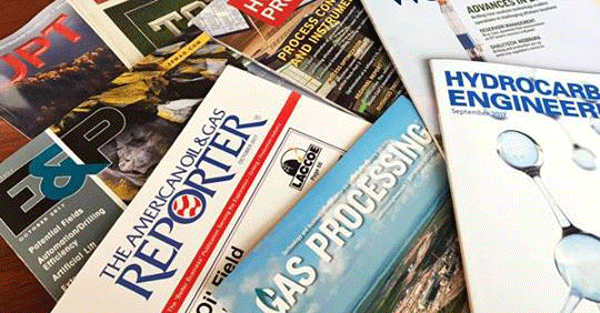
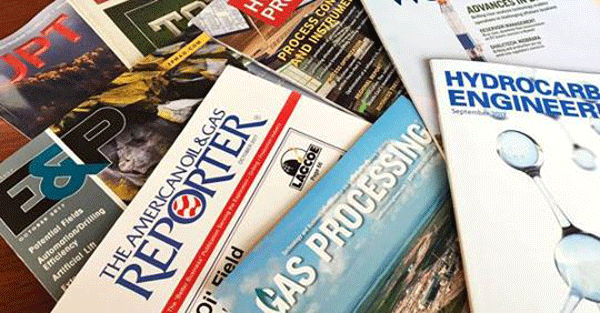
Writing is not just an activity, it’s an art. However, for most people, it can be a challenging art to master. At Foster Marketing, we take your successfully completed groundbreaking project, innovative new technology or strategic new hire and effectively communicate the news to the global oil and gas industry.
However, an article doesn’t write itself. Once we have our hands on all the relevant information, actually writing compelling text requires self-discipline and an acute ability to separate important vs. frivolous details. This takes time, thought and above all, experience.
Here are a few secrets, accumulated from years of experience that can help craft a dull, unorganized and uninformative piece into a valuable technical industry resource. Following are basics to improve your writing!
Pre-planning
The foundations for writing a good article are laid before you even open a Word document.
Know Your Audience: First you need to make sure you know “what” you are writing about, “who” you are writing for and “why.” For your target audience to engage with your message, you must keep them in mind while writing every single word. Never forget “why” you wanted to communicate with them in the first place.
Gather the Information: Before you write, make sure you have all of the relevant information you need. This will prevent you from having to go back and forth to gather more. It’s okay to have blanks to fill in at a later date, but make sure all of the key ideas are in place, ready to build upon. One thing you do not want to lose when you start writing is your “creative flow.”
Create an Outline: Creating an outline is the best way to organize your ideas, including the main idea, subtitles and the body of your article. By creating an outline, you can have the foundation of your article finished before you begin the hard work of putting the words into sentences and the sentences into paragraphs.
Less is More …
… Especially when you have a word count to adhere to. It is important to eliminate any ideas or unnecessary words that do not add value to the article. Don’t force your readers to sift through a sea of words to find the important information – your main points should stand out.
Vary Sentence Structure: Paragraphs that do not flow well are hard to read. Vary your sentence structure with a variety of simple and complex sentences, so the text does not end up feeling too heavy or too light in tone.
Make it Visually Appealing: We are hard-wired to see text as shapes. Make sure that your paragraphs are visually appealing. Break up that super long paragraph into two smaller ones and people will be more inclined to continue reading without feeling like they need to stop to take a nap.
Proofing
Don’t Overlook the Large Text: Headlines and subheads are the largest text on the page, but easily overlooked from a proofing standpoint. Give them the attention they call for!
Read the Copy in Random Chunks: Reading the copy in a variety of disordered chunks stops you from getting lost in the content and helps you guard against the mistake of reading what you expect to see.
Look Out for Then, Than and That: Your spell-check sometimes doesn’t catch these. Misplaced but otherwise correctly spelled words have become one of the most frequent grammatical mistakes in typed documents.
The Bigger Picture
Avoid the Sales Pitch: An article represents your company and provides the opportunity to showcase the voice or personality of your company. Avoid writing articles with very little flair for language or an article containing “fluff.” Your article shouldn’t be a disguised form of advertising, instead, it should be a useful technical resource. Any story for external communication must have an interesting and relevant point to make, and must have significant value to offer to the industry.
Demonstrate Thought Leadership: The article must demonstrate the thought and intelligence of the company, and also stimulate the reader. You’ve probably heard the term “food for thought.” It should leave the reader thinking about the applications of the new technology for their particular company. A great article is created as a response to real needs, issues and developments in today’s oil and gas industry. We encourage clients to promote their most recent project work and to discuss current and future technical developments and their reasons behind pursuing them.
Make It Readable: Any writing should have a narrative that holds everything together and makes it readable. If you consider the vast amounts of media that are fighting for a reader’s attention, it is important for your article to be clear, concise and easy to read.
When writer’s block strikes, or if you just don’t have the time, contact our experts at Foster Marketing for your article writing needs! Call us today 337-235-1848 to set up a meeting with our experts!
Jul 1, 2019
Not only having a plan but using common sense can ease the negative impact.
In our agency library we have a sample copy of an eight-year-old Crisis Communication Plan for British Petroleum (BP). It includes 30 pages of information on what to do in a crisis. To our way of thinking, however, it’s too heavy on listing internal point people and external media contacts and outlets (about 25 pages)…and relatively short on reality. But at least it’s a plan.
The BP oil disaster is a classic case history of what can happen when you have a plan but you don’t factor in the local equation. Many times, flawed communications at the local level hinder the public relations effort. As the prison warden in the movie Cool Hand Luke slowly shared with the convicts after catching escapee Paul Newman: “What we’ve got here is … failure to communicate.”
When crises hit, there is a tendency to centralize the response at headquarters, notes Irving Schenkler, director of the management communication program at New York University’s Stern School of Business. Public relations efforts frequently fail to take local customs and peculiarities into account. Schenkler says, “There’s a systemic problem in these situations in communication flow, and how sensitive communication is calibrated and delivered.”
As a result, foreign executives frequently place the wrong foot forward – or into their mouths.
When BP’s Swedish chairman, Carl-Henric Svanberg, emerged from a marathon meeting at the White House on June 16, he assured the American public that he and BP were concerned about the “small people.” Swedes, who are considered among the best English-speakers in Europe, were embarrassed by Svanberg’s lack of understanding of American politics, where journalists may refer to “average people,” but populist politicians like Sarah Palin call them “real Americans.”
In the early part of the crisis, BP CEO Tony Hayward’s remarks that the spill was small relative to the vast Gulf of Mexico and his complaint that he just wanted his life back — reinforced the sense that Hayward wasn’t fully engaged in the effort to clean up a mess far from his corporate home.
What is strange is that the thrust of BP’s old Crisis Communications plan is to engage the media on a local level, both internally and externally. Local internal contacts and local newspapers and TV/radio stations along the Gulf are all listed. However, this disaster and BP’s response was deemed beyond the local level and ability and media interest. And, certainly it is.
How are you going to respond in a crisis?
Chances are good your company has an internal plan for what to do in case of an emergency, but what about handling the public aspect of a crisis? What will you do to prevent negative media from spoiling the reputation that your company has worked so hard to build? How will your company appear under pressure?
Unfortunately, companies are all too often caught off guard and unprepared to navigate the communications challenges and opportunities that arise during times of crises.
Some companies operate under the mind set that they’ll cross that bridge if they come to it. But, when a crisis happens, having a well-thought-out, coordinated crisis communications plan in place that integrates all your public communications can greatly help minimize negative publicity and protect your company’s reputation.
From a public relations perspective, a “crisis” can be considered anything that will bring intense negative attention to your company – anything from an explosion at a plant to financial and investor worries to troublesome lawsuits. But there are several reasons why companies need to have a plan in place, regardless of the type of crisis.
When a problem happens, time is of the essence. You need to act quickly to respond to concerns or criticism. Immediately responding to negative and possibly incorrect information leaves less time for those thoughts to resonate with people and more time for your company’s message to be heard. As we’ve seen with BP’s current situation, it can be difficult to repair the damage done by inaccurate information and the perception that you haven’t acted quickly enough, i.e. how many barrels of oil were actually flowing from the well. Planning ahead reduces the time spent trying to organize communications efforts – time that you won’t have in the event of an emergency.
It is important to be coordinated, confident and caring. In times of trouble, one of the most important things a company can do is to portray strength, organization, confidence and capability. A strong front can go a long way toward easing fears and erasing misconceptions. Having a plan in place that employees are comfortable and familiar with reduces uncertainties and helps those involved react with confidence. It shows customers and shareholders that the company is capable of handling difficult situations with poise. Also, the public wants to see that your organization is genuinely concerned for those affected and that you truly want to make it right.
Advanced planning ensures all the necessary pieces are in place. Does your company have someone that is prepared to serve as a spokesperson? Will the website handle heavy traffic if it receives a surge of visitors? Have you built relationships with relevant media? These are just a few of the many questions faced during a crisis that take time to answer and cannot be adequately addressed in a hectic and short amount of time.
If properly prepared, crisis situations can reveal unique communications opportunities.While it’s not entirely true that there’s no such thing as bad publicity, it is important to look for the silver linings and opportunities that can present themselves during troubled times.
• Increased website traffic – A company’s website is one of its greatest advocates and platforms for getting its message out. Always have your company’s website prepared for a crisis situation by making sure the site highlights the company’s capabilities and strengths and that it is able to handle high traffic.
• Open dialog – When a crisis happens, you’re immediately thrown into a conversation. Once the dust settles and that conversation ends, it’s important to continue that dialog. Use the doors that opened through that situation to continue your company’s communications efforts. When participating in these conversations, don’t forget about the role social media and networking sites now play.
• Opportunities to show growth and improvement – One of the ways to keep the conversations going is by continuing to provide feedback on some of the issues that were discussed. For example, maybe your company strengthened its safety requirements after an accident. Take that opportunity to highlight the company’s initiative to improve and protect its employees.
• Identify weaknesses – In the same way troubled times reveal opportunities, they undoubtedly uncover weaknesses. Thoroughly evaluate your company’s communications efforts after a crisis, as well, and identify areas that need improvement. You’ll be even more prepared should another problem arise.
A comprehensive, integrated crisis communications plan can be a lengthy and time-consuming process, but it’s a sound investment.
Foster Marketing Communications can help you put that plan together – or hone it. And, you can be sure we’ll be there to support you if a crisis happens.