Every marketing team eventually hits a plateau. The growth curve flattens, leads become more expensive, and the question echoes through planning meetings: “What’s next?”. Finding your next major win isn’t about chasing trends or a lucky guess; it’s a process of strategic deduction. It requires you to examine the evidence you already have to form a data-backed plan.
Think of it like the classic board game Clue. The data points you collect across your platforms are your clues, telling you who did what, where, and with which tool. In this game, the rooms are your marketing channels, the suspects are your audience segments, and the weapons are your marketing tactics. Your job is to gather clues from each room to solve the mystery: Which audience needs what tactic in which channel to drive our next win?
This detective’s mindset shifts the focus from guesswork to evidence. It’s about spotting patterns in your analytics and customer feedback, forming a hypothesis, and testing it methodically.
Uncovering Clues in Your Data
Your analytics are dropping hints everywhere. The key is to understand what they mean and how to act on them. Here are five common scenarios you might find in your own data, along with a framework for turning those clues into a strategic next move.
The High-Engagement Newsletter
Your email newsletter consistently generates direct replies from readers asking detailed follow-up questions about a specific topic. They aren’t just clicking; they are actively engaging with the content and asking for more.
- What it suggests: A core group of your audience, likely power users or highly engaged prospects, is signaling a need for deeper, more interactive content on this subject.
- Your next move: Compile these questions and host a quarterly “Ask Me Anything” webinar with your top subject matter expert. This directly addresses their stated needs in a high-value format.
- Hypothesis: Promoting an “Ask Me Anything” webinar exclusively to your newsletter list could achieve a high attendance rate and uncover specific pain points that can inform future white papers or product features.
The Viral Infographic
An infographic you created months ago continues to get high engagement and is widely shared across various social platforms. Its visual format made a complex topic easy to understand and distribute.
- What it suggests: The topic and visual format resonate strongly across multiple audience segments and social channels. There is a clear appetite for this information when presented in a digestible way.
- Your next move: Repurpose the successful infographic into a more detailed asset. You could develop an animated video that walks through the data or host a webinar that expands on each point. Use the original graphic as a promotional tool for the new content.
- Hypothesis: Repurposing this proven visual content into a gated, in-depth asset (like a webinar or video) will generate new marketing-qualified leads (MQLs).
The Underwhelming Trade Show
You return from a significant trade show with a stack of badge scans, but very few of them translate into scheduled meetings or qualified pipeline of leads. The initial interest captured at the booth seems to fade before your sales team can effectively follow up.
- What it suggests: The passive, post-event follow-up process is failing to capitalize on the interest generated in person. The delay between the conversation and the follow-up is too long.
- Your next move: For your next event, implement a pre-show booking strategy that allows key prospects to schedule meetings and demos in advance. Supplement this with a rapid-response email sequence for all booth visitors, sent within 24 hours of the badge scan.
- Hypothesis: Pre-booking meetings will secure time with high-intent prospects, while a rapid follow-up sequence will increase post-show engagement and lead conversion rates.
The Post-PR Traffic Surge
Following a press release or positive media mention, your branded search traffic surges. However, analytics show that most of these new visitors arrive on your homepage and leave without clicking to another page.
- What it suggests: New prospects are curious about your brand name after hearing it, but they don’t find a clear, relevant path forward once they land on your site.
- Your next move: Create a simple “As Seen In” section on your homepage that directs traffic from recent PR to a dedicated landing page. This page should provide more context about the announcement and a clear call-to-action.
- Hypothesis: A dedicated landing page for PR-driven traffic will decrease the homepage bounce rate and guide curious visitors toward relevant content, increasing their session duration.
The High-Dwell Case Studies
Your case studies show higher than average time on the web page, indicating people are reading them thoroughly, yet very few of those engaged readers click the “Request a Demo” button at the end.
- What it suggests: These readers, likely technical buyers or researchers, are convinced of your results but aren’t ready for a sales conversation. The leap from reading a case study to requesting a demo is too large.
- Your next move: Offer a “softer” conversion. Instead of pushing for a demo, add a secondary call-to-action like “Download the Full Project Data Sheet” or “Watch the 5-Minute Project Overview Video” in exchange for an email.
- Hypothesis: Offering a mid-funnel content asset on case study pages will increase lead conversions from this highly engaged traffic by giving them a relevant next step that doesn’t involve a sales commitment.
From Investigation to Closing the Case
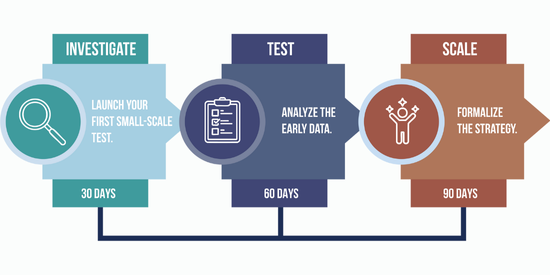
Once you have a promising clue and a solid hypothesis, it’s time to build your case with a structured plan. A simple 30-60-90 day framework prevents big ideas from becoming overwhelming and ensures you track progress effectively.
- First 30 Days (Investigate): Launch your first small-scale test. Send the AMA webinar invite, start pre-scheduling meetings for the next trade show, or build that new landing page for PR traffic. Measure the initial results against your hypothesis.
- Next 60 Days (Test): Analyze the early data. Are you seeing AMA registrations? Have you booked more pre-show meetings? Did the bounce rate on the new landing page decrease? Use these findings to refine your approach. If the results are positive, consider a second, slightly larger test.
- Next 90 Days (Scale): Once you’ve proven the concept works, it’s time to formalize the strategy. Turn the one-off AMA into a recurring webinar series, standardize the pre-booking process for all events, or build a template for PR landing pages. This is where you scale the win across the marketing organization.
Your next big marketing win is already waiting in your data. The clues are scattered across your dashboards, in your customer emails, and in your sales team’s feedback. By adopting a detective’s mindset, you can stop guessing and start building a data-backed case for success.
Foster Marketing can help you solve your next marketing mystery. We’ll help you uncover the clues in your data and map out your next winning move. Contact us today!